Renamed: before it was CDOM, it was yellow substance
Ocean and lake optics has called the same dissolved colour by at least four names since the 1950s. In our corpus, 205 papers use only the old ones.
Key findings
- In our corpus of 438,288 papers, 143 use the phrase "yellow substance"; the earliest is from 1953, use peaks at 45 papers in 2000 to 2004, and only 5 have used it since 2020.
- Its replacements, coloured, colored or chromophoric dissolved organic matter, first appear in 1991, outnumber the old name within the 1990s, and are used by 1,370 papers.
- A search for the newer names misses 205 papers that use only "yellow substance" or the German "Gelbstoff".
Look at a lake, or the sea near a river mouth, and the water often has a faint yellow-brown tint. Part of that colour comes from organic matter dissolved in the water, much of it from decaying plant material. It absorbs ultraviolet and blue light strongly, which matters for how far sunlight reaches down and for satellites trying to measure chlorophyll from space.
It has had at least four names. Kurt Kalle, a German marine chemist who studied it in coastal waters from the late 1930s, called it Gelbstoff, "yellow substance", after the yellowish, humus-like tint it gives the water. In English the translation stuck for decades, and a smaller literature on lakes called it gilvin. Today most papers call it coloured dissolved organic matter, or CDOM.
So we counted, the same way we did for marine heatwaves.
The switch, in our corpus
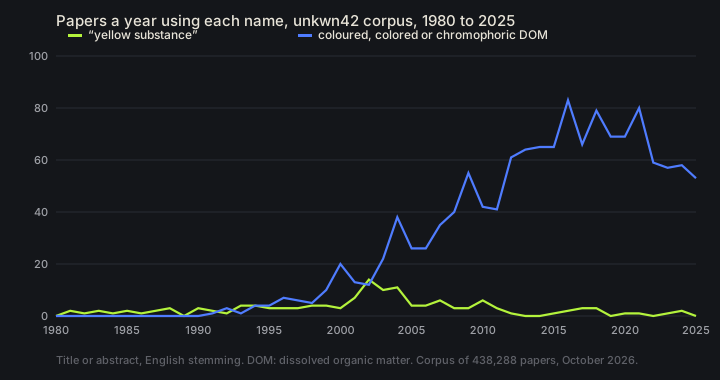
143 papers in our corpus use "yellow substance". The earliest we hold is a 1953 paper by Jerlov on how suspended and dissolved matter affect the transparency of sea water. Use of the phrase rises to a peak of 45 papers in 2000 to 2004, then falls away: 20 in the next five years, then 10, then 9, and 5 since 2020.
The newer names first appear in 1991 and overtake the old one within the same decade, 41 papers to 31 in the 1990s. By now 1,370 papers we hold use them, 407 of those since 2020. Only 16 papers use both the old name and a new one in their title or abstract.
The German word never quite left either. 101 papers in our corpus use "Gelbstoff" in English text, the first in 1961, and 94 of those never say "yellow substance". Gilvin turns up in 11 papers between 1976 and 2011, most of them about light in lakes and other inland waters.
Even the new name splits
The C in CDOM gets spelled out two ways. "Coloured" or "colored" dissolved organic matter appears in 828 of our papers, "chromophoric" in 553, and they mean the same thing. One of the most cited papers on its optical properties, Green and Blough (1994), uses "chromophoric". So even within today's vocabulary, a search for one spelling misses most of the papers that use the other.
Do the two literatures read each other?
Partly. We read the reference lists of the most cited papers on each side, up to 120 a side, using OpenAlex. Of the 120 most cited papers that use only the newer names, 39 (32%) cite at least one paper we hold that uses only "yellow substance". 102 (85%) cite a paper that uses their own name.
The classics survived the rename. Bricaud, Morel and Prieur (1981) has "yellow substance" in its title and is still one of the most cited papers in the area. What these numbers can't tell me is how much of the rest of the old literature is still read. About two thirds of the most cited newer papers don't cite any paper we hold that uses only "yellow substance". Some of that is fine, because newer measurements replace older ones. Some of it is work that people stopped finding once they stopped searching for its words.
What to search for
If you work on the optics of dissolved organic matter, a search for the newer names alone leaves out 205 papers in our corpus that use only "yellow substance" or "Gelbstoff". Searching every name, including both spellings of the new one, costs a minute.
The harder case is the field you don't know well, where you can't know which old names to try. That's the gap unkwn42 is built to cover. The check finds earlier papers that make the same point in other words, and marks the ones filed under a different name. You can run it on your own paper.
How we counted
Title or abstract, with English stemming so plurals count, across 438,288 climate and earth science papers from OpenAlex. That's our corpus, not the whole literature, so read the shape of the curves rather than the totals. It also holds fewer papers a year after 2021, about 16,000 a year from 2022 to 2025 against about 20,000 in 2020 and 2021, so the dip at the right of the chart is partly ours rather than the field's. The citation figures come from OpenAlex reference lists, read on 22 October 2026.
Sources
- Jerlov NG (1953). Influence of suspended and dissolved matter on the transparency of sea water. Tellus 5(1): 59-65. doi.org/10.3402/tellusa.v5i1.8562
- Bricaud A, Morel A, Prieur L (1981). Absorption by dissolved organic matter of the sea (yellow substance) in the UV and visible domains. Limnology and Oceanography 26(1): 43-53. doi.org/10.4319/lo.1981.26.1.0043
- Green SA, Blough NV (1994). Optical absorption and fluorescence properties of chromophoric dissolved organic matter in natural waters. Limnology and Oceanography 39(8): 1903-1916. doi.org/10.4319/lo.1994.39.8.1903
- University of Oldenburg (2012). The rediscovery of "sky-blue fluorescence", on Kurt Kalle's work.